
-
By Eden Engineering
-
March 13, 2026
Free Heating for Precision Temperature and RH Control
Using Condenser Water Directly via Heat Exchanger Instead of Heat Pump or HRU
Precision temperature and relative humidity (RH) control are essential in modern facilities such as pharmaceutical laboratories, semiconductor cleanrooms, healthcare environments, and research facilities. These environments typically require tight control of supply air dew point to maintain indoor RH stability, often achieved by deep cooling followed by reheating.
Traditionally, reheating is accomplished using electric heaters, hot water boilers, or heat pump–based heat recovery units (HRUs). While effective, these methods introduce additional energy consumption. However, in facilities equipped with central chilled water plants, there exists a significant and often underutilized source of thermal energy: the condenser water loop.
The Conventional Approach: Active Heating Requires Additional Energy
In a typical chilled water system, air handling units (AHUs) dehumidify air by cooling it below its dew point using chilled water coils. This overcooling is necessary to remove moisture but results in supply air that is too cold for direct delivery into the space. Therefore, reheating is required to bring the air to the desired supply temperature while maintaining low moisture content.
Common reheating methods include:
- Electric duct heaters
- Hot water boilers
- Heat pump water heaters or heat recovery units (HRUs)
All of these systems consume additional electrical or fuel energy to generate heat. Even heat pump-based HRUs, while efficient, still require compressor energy to elevate the temperature of the heat source.
The Untapped Opportunity: Condenser Water as a Passive Heat Source
In any water-cooled chiller plant, condenser water continuously carries rejected heat from the chillers to the cooling towers. This condenser water typically operates at temperatures such as:
- Condenser Water Supply (CWS): 28-31 °C
- Condenser Water Return (CWR): 33-36 °C
This heat is normally rejected to atmosphere via cooling towers and effectively wasted. However, this condenser water represents a stable, continuous, and completely free heat source.
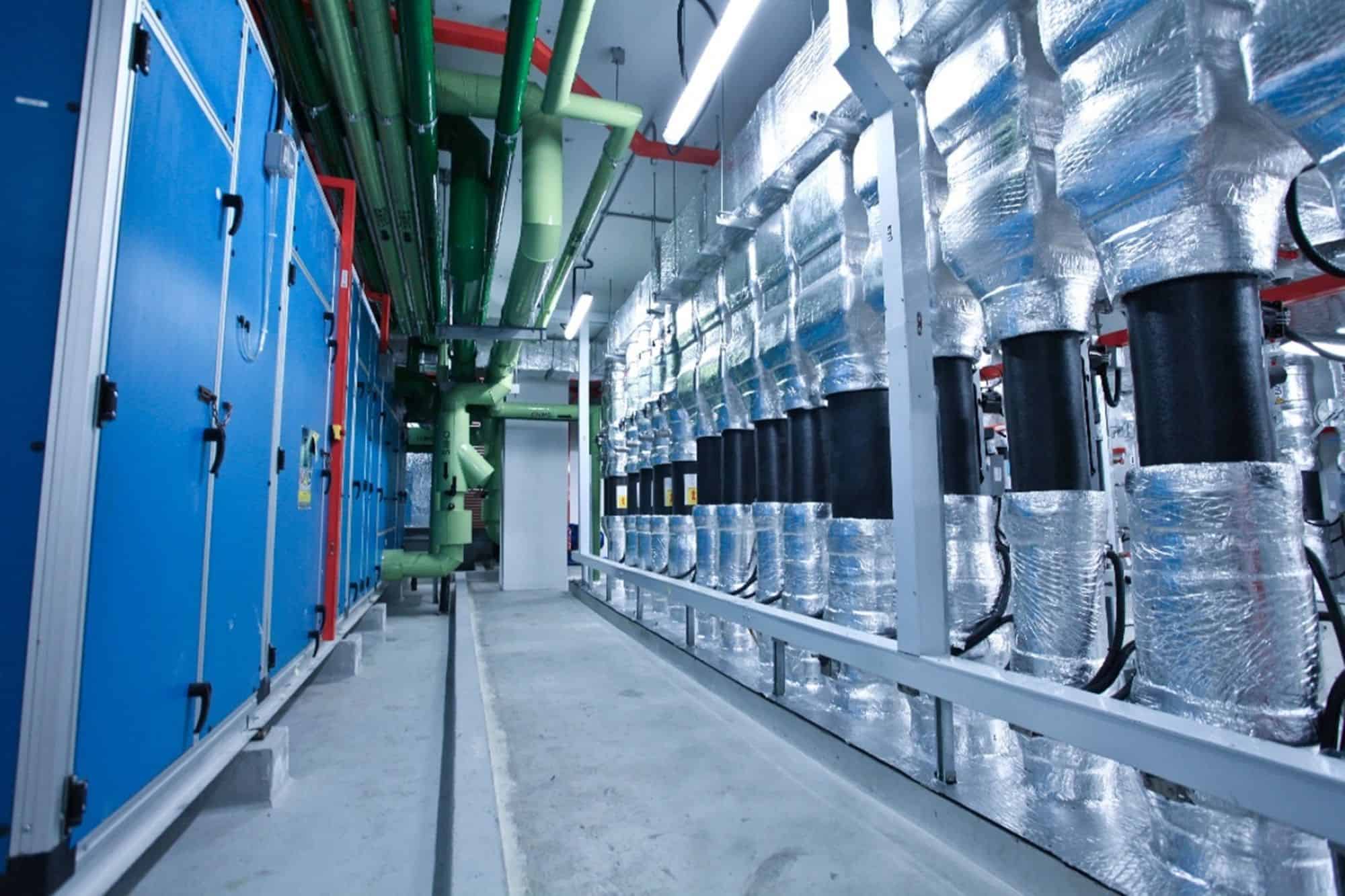
By installing a heat exchanger between the condenser water loop and a secondary hot water loop, this heat can be directly transferred to serve air-side reheating applications.
Importantly, this method requires no compressor and no additional thermal energy input.
Application in Precision RH Control Systems
In precision environments, reheating requirements are typically moderate in temperature but continuous in operation. For example:
- Supply air after dehumidification: 12-14 °C
- Required supply air temperature after reheat: 16-20 °C (varied by heat load in space)
This temperature increase can be readily achieved using hot water in the range of 30-40 °C. Condenser water operating at 33-36 °C is ideal for this purpose.
Through a properly designed heat exchanger, the secondary hot water loop can achieve temperatures sufficient for reheating without any active heating device.
This creates a fully passive heat recovery system.
Energy Impact and System-Level Benefits
The benefits of using condenser water directly for reheating include:
Zero Compressor Energy Consumption
Reduced Cooling Tower Energy Consumption
Improved Overall Plant Efficiency
Lower Capital and Maintenance Costs
Comparison with Heat Pump-Based Heat Recovery
| Aspect | Passive Condenser Water HEX | Heat Pump / HRU |
| Compressor required | No | Yes |
| Additional electrical input | Negligible | Yes |
| Heating temperature capability | Moderate (around 34 °C) | High (up to 60 °C+) |
| Maintenance complexity | Low | Higher |
| Overall system efficiency | Excellent | Moderate to Good |
| Best application | Air-side reheat | High-temperature heating or domestic hot water |
Passive condenser water recovery is particularly suitable for reheating applications where moderate temperatures are sufficient.
Design Considerations
To implement this system successfully, several key design considerations should be addressed:
- Install a plate heat exchanger between the condenser water return line and the secondary hot water loop.
- Provide proper control valves to regulate secondary hot water temperature.
- Ensure adequate condenser water flow to maintain stable heat transfer.
- Protect chiller operation by ensuring condenser water temperatures remain within manufacturer limits.
When properly designed, the system operates seamlessly alongside the chiller plant.
Realizing Truly “Free Heating”
In facilities where chilled water systems operate continuously, condenser water heat recovery represents one of the most effective opportunities for energy optimization.
By using a passive heat exchanger, reheating energy can be obtained without compressors, without additional electrical consumption, and without additional heat generation systems.
This transform rejected heat from a waste product into a valuable energy resource.
Conclusion
Passive heat recovery from condenser water offers a simple, reliable, and highly efficient method for reheating in precision temperature and humidity control applications.
By directly utilizing condenser water through a heat exchanger, facilities can eliminate or significantly reduce the need for active heating systems such as heat pumps or HRUs.
This approach improves overall plant efficiency, reduces operating costs, lowers maintenance requirements, and contributes to sustainable building operation.
In precision environmental control, sometimes the most efficient heating system is not one that generates heat – but one that simply recovers heat that already exists.